Opting out of Oligarchy EXPOSED!

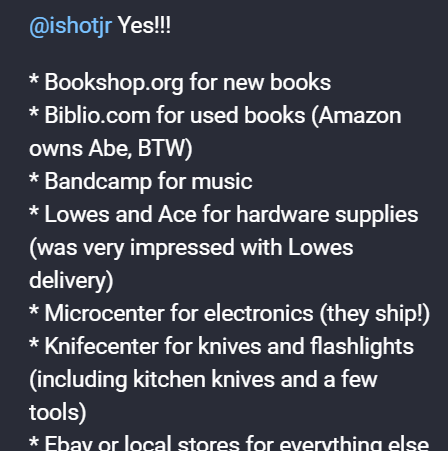
I think it was canceling Amazon Prime that kicked things off. With my renewal looming on January second, I took a moment to consider whether the $147.34 I hand over each year ($139 + 6% Michigan sales tax) to pretend that Amazon orders come with free shipping was worth it. It was New Year’s Eve. I had departed Hamburg at around 6am local time on just a few hours’ sleep, and it was now past 10pm in Detroit (i.e. more than 24 hours after I’d woken up that “day”). The lack of sleep, as well as the fact that I had just returned from a mind-blowingly egalitarian and anti-authoritarian German hacker event, 39c3, probably helped. So I did it: I pressed pause on Prime. It’s been almost a month, and I haven’t felt a thing. But I’ve also not really found replacements for everything I depended on Amazon for, versus abstaining on purchases and making do with what I have – itself of course a pleasant side effect. Amazon ordering has not necessarily been obviated completely, but I’ve made a commitment to find replacements, even if not all of them have been discovered or proven yet. A couple of weeks ago, I crowdsourced Amazon alternatives via Mastodon, and got some fantastic suggestions. But there was a problem: I’d gotten a taste for opting out from the oligarchy’s offerings, and I wanted to take it further. So I came up with a simple rubric to define how I would engage in commerce: no more increasing the wealth of billionaires.

After searching via DuckDuckGo (which I am going to stop using after I am finished writing this, due to founder Gabriel Weinberg’s $1.5 billion net worth), I learned via Business Insider (also on the chopping block due to parent company Axel Springer SE’s CEO’s Mathias Döpfner $1.3B net worth (according to Forbes, whose majority owner Whale Media Investments’ leading investor Yam Tak Cheung’s net worth puts them out of contention at $1.3B)) that Amazon founder Jeff Bezos’ net worth has reached a nauseating $257B as of January 2026. I don’t want whatever tiny amount my retail purchases may amount to to contribute to his wealth. In fact, according to Oxfam (no billionaire ownership to worry about there!):
Billionaire wealth has increased by 81 percent since 2020. This comes as one in four people don’t regularly have enough to eat and nearly half the world’s population lives in poverty.
The collective wealth of billionaires last year surged by $2.5 trillion, almost equivalent to the total wealth held by the bottom half of humanity – 4.1 billion people.
The $2.5 trillion rise in billionaires’ wealth would be enough to eradicate extreme poverty 26 times over.

This is how I arrived at my goal of extricating all services and vendors under the control of billionaires from my personal life. I don’t expect it to be easy, nor do I expect instantaneous or comprehensive success, but I think using it as a compass as I make decisions about what I buy and what technology I use will be helpful. So let’s look around and see what has to go…
Microsoft – I guess Bill Gates is kind of a weird case, being the only billionaire whose house I’ve eaten dinner at (a couple of times). The richest man throughout most of the 90s and aughts almost seems like a quaint, “good kind” of billionaire compared to today’s sort, but whether we file Microsoft under its remaining living founder, or under current CEO Satya Nadella ($1B) it’s gotta go. That means Windows, Office (I’m using Word to draft this now), and, probably hardest of all, GitHub. Most of my Windows machines at least dual-boot to Linux, but I constantly find myself booting to Microsoft’s OS to use its Office tools, which I actually pay for out of my own pocket because of how superior I find them to the competition. OneNote, my daily note-taking companion, will also be hard to forego, but less so after being forced from the lightweight OneNote for Windows 10 to … well I can’t even tell you the name or version of the thing that replaced it, since they’ve removed the Help -> About dialogue that’s been present in almost every app since I’ve been using computers with some useless interactive search that doesn’t really seem to work at all (much like OneNote’s primary Search functionality).
Google – I gave up Google Search a long time ago, but use Google Apps/G Suite/Google Workspace/whatever it’s called today for my personal email and calendar. I also use an Android phone, and occasionally watch old episodes of Dr. Katz as well as things like the Dakar Rally on YouTube. I can see transitioning to Proton Mail and Calendar (no billionaires in the Proton Foundation or subsidiary Proton AG). There are plenty of other places to find video content. Finding an alternative phone operating system may prove a challenge though.
Spotify – as if there weren’t enough reasons to want to avoid this platform and its cofounder, Daniel Ek’s $7.7B net worth means sayonara to the streaming platform. I tried this once before with Tidal, but found that platform’s catalog depth lacking, and I already support my favourite artists via Bandcamp (no info found around founder Ethan Diamond’s or current owner Songtradr’s Paul Lancaster Wiltshire’s net worth), vinyl purchases, and going to live shows.
Twitter, Instagram, Facebook – I discontinued use of Twitter as soon as the poster boy for why billionaires shouldn’t exist took over, and ceased my one or two Instagram posts per year after least-cool-guy-on-the-Internet Zuck’s bizarre “back to our roots” speech early last year. I’ve never been a Facebook user because I’m not 100 years old. I use Mastodon and Pixelfed on the few occasions that I feel like sharing, and have found incredible communities on both.
I’ve always avoided Walmart because it seemed problematic, and although I am not sure how tied to billionaires it might be, I’m avoiding Kroger as well. I was quite disturbed to discover while researching this that Trader Joe’s is owned by Aldi, whose heirs have net worths of $16B; that will be a hard one to give up, and I thought I was supporting the “little guy” against the likes of Kroger and Walmart. Thankfully it seems I may be in the clear with the Lenovo laptop I’m writing this on, since founder Liu Chuanzhi isn’t worth close to $1B.

So, this is just the start of a journey in which I try to be more deliberate with the money I spend and the services I use. I think it ties well with a lot of other things I see happening in the world – not least those highlighted by Cory Doctorow’s speech at 39c3, “A post-American, enshittification-resistant internet” and the actions I’ve observed of my friends disentangling themselves from various platforms and services in recent years. What problematic platforms and vendors are you trying to replace? What alternatives can you suggest to me as I attempt to make changes in my life? I think the best way through this is working together to help and inform each other, and express our values with our combined wallets and abstentions. This is just the start, and I’ll share more (ideally on a non-GitHub-hosted wiki!) as I discover solutions, become aware of blind spots, and hopefully start to feel a difference!

Bonus: check out the latest episode of DAY//GLOW, my hardware hacking livestream with Alex Glow!